How to turn your notes into effective practice questions
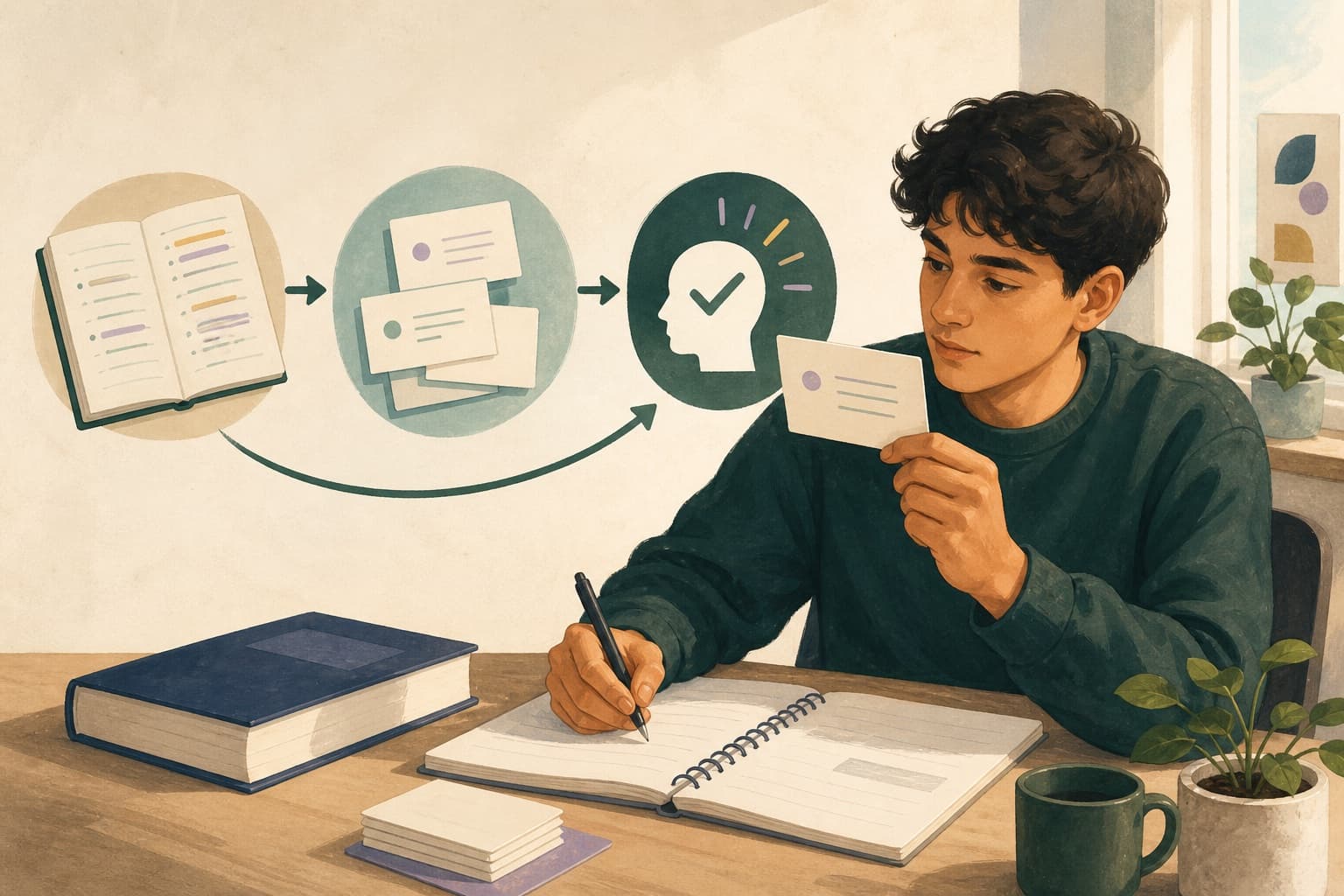
A method for converting lecture notes into questions that test recall and application rather than recognition, with examples of weak questions rewritten.Write questions that force you to produce an answer rather than recognize one. Take each note heading and ask what the exam could ask about it, then write the question so the answer cannot be guessed from its wording. Cover the note, answer from memory, and check. A question you can answer by looking at the note you wrote it from is testing your eyes, not your memory.
Recognition feels like knowledge and is not
Rereading notes produces a strong feeling of familiarity. The material looks known, the concepts seem obvious, and the natural conclusion is that you have learned it. Then the exam asks you to produce the same content without prompts and it will not come.
The gap is between recognizing information when it is in front of you and retrieving it when it is not. These are different operations, and only one of them is what an exam tests. Practice questions are valuable precisely because they force the second one, and they only work if they are written so that recognition cannot substitute for retrieval.
The conversion method
Work through your notes section by section rather than line by line. Line-by-line produces trivia; section-by-section produces questions at the level the exam actually asks.
- Take a heading, not a sentenceEach heading or subheading in your notes represents a chunk the instructor treated as a unit. That chunk is roughly the size of an exam question.
- Ask what could be asked about itFor each chunk, write down the questions an exam could reasonably pose: define it, explain why it happens, compare it to the adjacent concept, apply it to a case, predict what changes if one variable moves.
- Write the question so the wording does not give the answerThis is the step that separates useful questions from useless ones. If the question contains the technical terms from the answer, you will pattern-match rather than retrieve.
- Write the answer separately, in fullNot keywords. If you cannot write the full answer now, with the notes open, you do not understand it yet and the question has already done useful work by surfacing that.
- Test cold, at least a day laterCover the notes, answer from memory, then compare against what you wrote. The delay matters: answering immediately after writing tests short-term memory rather than learning.
Weak questions and their rewrites
Most first-attempt practice questions fail in one of three ways. Each has a mechanical fix.
- Too much given away: 'What is the role of the sodium-potassium pump in maintaining the resting membrane potential?' names the mechanism and the outcome, leaving only assembly. Rewrite as 'How does a neuron maintain its resting membrane potential?'
- Answerable with one word from recognition: 'Is inflation measured by CPI?' has a fifty percent guess rate. Rewrite as 'Name two ways inflation is measured and explain what each one misses.'
- Testing the note rather than the concept: 'What were the three points in the lecture on market failure?' tests whether you remember a slide. Rewrite as 'Give an example of a market failure and explain which condition for efficiency it violates.'
Cover the levels the exam covers
A set of questions that only asks for definitions will prepare you for the first ten percent of an exam. Deliberately write across levels.
Definitions and facts are the base and they are necessary, but they are the cheapest questions to write and the least useful to practise beyond the first pass. Explanation questions ask why something happens. Comparison questions ask how two similar things differ, which is where most exam distractors live. Application questions give a new case and ask what happens, and these are the ones that predict exam performance best because they cannot be answered from memorized text at all.
A reasonable mix for a typical course is a minority of definitional questions and a majority split between explanation, comparison, and application. If every question you have written is a definition, you have built a glossary rather than a practice set.
Space the practice, and keep the ones you get wrong
Practice questions are most useful revisited over time rather than drilled once. Answer a set, set it aside for a few days, and answer it again. The second attempt is where you find out what actually stuck.
Keep a separate pile for questions you got wrong. Those are the highest-value items you own, because they are precisely the places where your confidence and your knowledge disagree. Most students do the opposite, revisiting the questions they can answer because it feels better.
A worked example: one page of biology notes
A page of notes on enzyme kinetics with four headings: enzyme structure and active sites, factors affecting reaction rate, competitive versus non-competitive inhibition, and the Michaelis-Menten relationship.
- Heading three, inhibition, becomes a comparison question rather than two definitions: 'An enzyme's reaction rate drops when a compound is added. What would you measure to determine whether the inhibition is competitive or non-competitive, and what would each result look like?'
- Heading two becomes an application question: 'A reaction runs at 20 degrees and pH 7. Predict what happens to the rate at 60 degrees, and explain the mechanism.'
- Heading one becomes an explanation question rather than a labelling exercise: 'Why does an enzyme lose function when its tertiary structure is disrupted?'
- Heading four is the hardest to write well, because the obvious question names the relationship. It becomes: 'What does the concentration at which a reaction reaches half its maximum rate tell you about the enzyme, and why is that value useful for comparing two enzymes?'
- Full answers are written for all four, from the notes, taking about twenty minutes.
- Two days later the questions are answered cold. Two are answered well, the inhibition comparison is half-remembered, and the Michaelis-Menten question cannot be answered at all. Those two go in the wrong pile and get revisited first.
Four questions covering three cognitive levels, about thirty-five minutes of total work, and a specific, evidenced list of the two things that need more attention rather than a general feeling of having studied.
Where this stops applying
- This guide describes the mechanism behind retrieval-based study rather than reporting effect sizes from any particular experiment. How much it helps varies by subject, by how the exam is written, and by how honestly you test yourself.
- Writing questions takes real time and is itself a form of studying, which means it is not free. For a course you are already comfortable in, working past exam papers is usually a better use of the same hour.
- Self-written questions inherit your blind spots. If you misunderstood a concept in the lecture, your question and your answer will both be wrong and will confirm each other. Check your answers against the source material, not only against your notes.
- Cold testing is uncomfortable, and that discomfort is the reason it works and the reason most people stop doing it. A study method that always feels good is usually testing recognition.
Generate the first draft, then edit it
Studyism turns notes, slides, and readings into practice questions grounded in your own material, which you review and correct before studying.Related reading
- Flashcards, practice questions, or rereading: which to use whenWhat each study method actually trains, when each one is the right choice, and why the most popular method is usually the least effective per hour.
- How to build a weekly study schedule that adaptsBuild a weekly plan around the time you actually have, with a rescheduling rule that lets it survive a bad week instead of being abandoned.
- What makes a good practice question?The properties that separate practice questions that build recall from ones that only test recognition.
- How do I identify my weak areas before an exam?How to find the topics you cannot actually produce, rather than the ones that merely feel unfamiliar.
- Are AI-generated practice questions reliable?How much to trust AI-generated study questions, what they get wrong, and how to use them without being misled.