How to turn a syllabus into a semester study plan
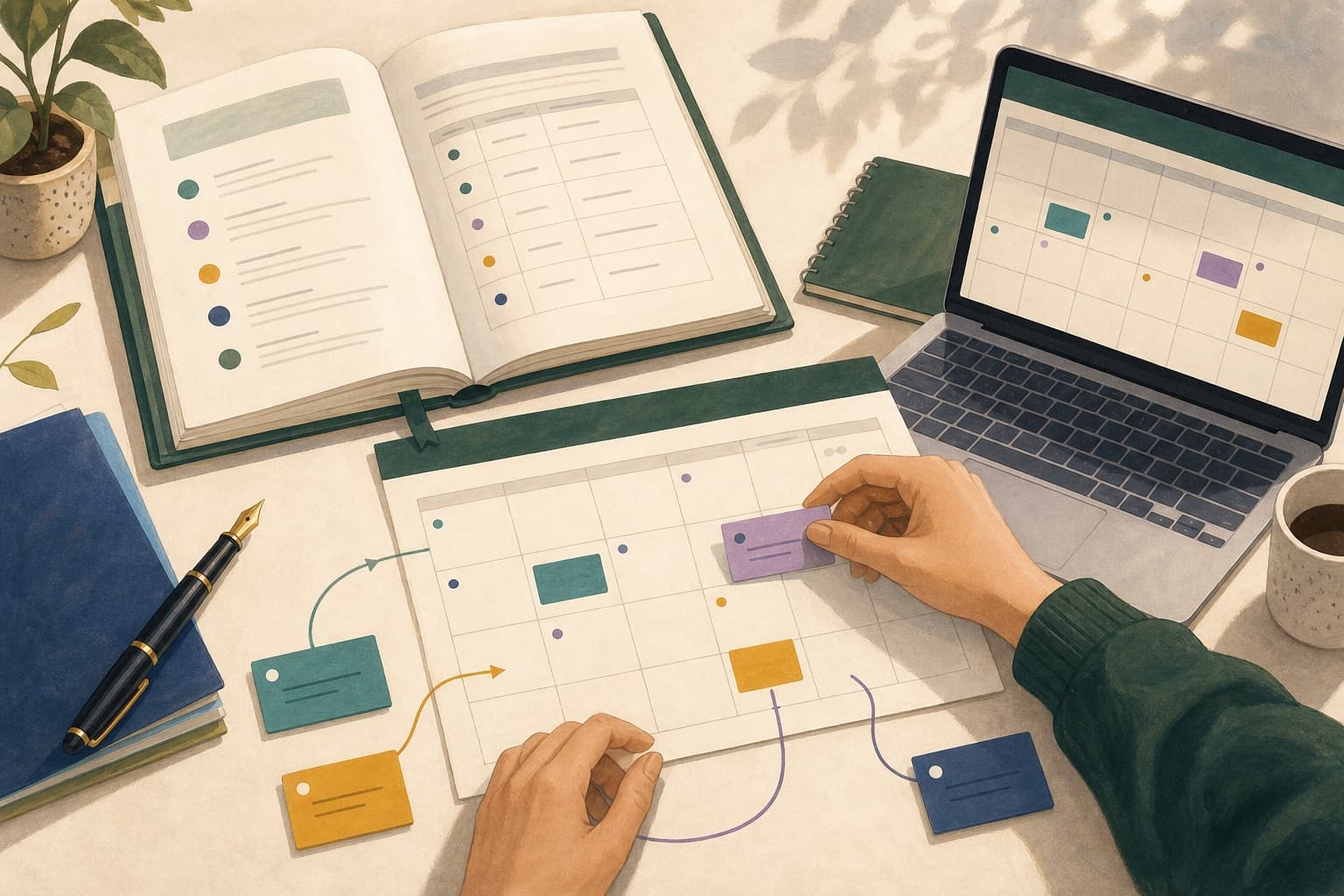
A step-by-step method for converting a course syllabus into dated, prioritized study work you can actually follow, including what to do when the syllabus is vague.Read the syllabus once for structure, then extract four things: graded items with dates, the grading weight table, recurring weekly work, and the exam schedule. Put every dated item on one calendar, then work backward from each deadline to place preparation time. Plan the first three weeks in detail and leave the rest as placeholders, because a semester plan built in week one is a forecast, not a schedule.
Read the syllabus once before you write anything down
The instinct is to open a blank calendar and start typing dates as you scroll. Resist it for ten minutes. A syllabus is a contract with a structure, and the structure is what makes the plan useful later: it tells you which weeks are front-loaded, which assessments compound, and where the course expects you to already know something.
On the first pass you are looking for shape, not detail. Is this a course with one enormous final project and light weekly work, or a course with a graded task every single week? Does the midterm sit in week seven, or week nine right on top of another course's midterm? You cannot see collisions until you can see shape.
Extract the four things that matter
Most syllabi are five to fifteen pages, and most of that is policy language you will never reread. Four categories carry nearly all the planning value. Pull them out in this order, because each one constrains the next.
- Every graded item with a dateProblem sets, papers, labs, quizzes, presentations, participation checkpoints. Write the date exactly as the syllabus states it, including the time of day if one is given. An assignment due at 11:59 PM and one due at the start of a 9:00 AM class are different assignments for planning purposes.
- The grading weight tableThis is the single most useful paragraph in the document and the one students skip most often. It tells you what the course actually rewards. A weekly quiz worth 2% and a final paper worth 30% are not both 'homework', and treating them as equivalent is the most common planning error there is.
- Recurring weekly workReadings, lab prep, discussion posts, problem sets on a fixed cadence. These rarely appear as calendar events anywhere, which is exactly why they silently consume the time you thought you had free.
- Exams and anything immovableMidterms, finals, presentation slots, field trips, required lectures. These are fixed points that everything else has to route around, so they go in first and never move.
Turn the grading table into a priority order
Once every graded item has a date and a weight, you can rank them by something better than deadline proximity. The question to ask of each item is not 'when is this due' but 'how much does this move my grade per hour I put into it'.
A 30% final paper deserves more total hours than a 2% discussion post, but that does not mean it deserves more hours this week. Weight tells you the size of the investment; the deadline tells you when the investment has to be finished. You need both numbers to decide what to open tonight, and a plan that only tracks one of them will reliably send you to the wrong task.
Write the weight next to each item in your calendar entry. It takes four seconds per item and it changes how every future scheduling decision feels, because the tradeoff is visible at the moment you are making it rather than after the grade posts.
Work backward from each deadline
A due date is when work is handed in, not when it is done. For anything larger than a single sitting, place the preparation before it and treat that preparation as the real appointment.
The backward pass is mechanical. Start at the deadline, subtract a buffer day, and then subtract the working sessions the task needs. A ten-page paper is not one ten-page event: it is a source-gathering session, an outline, a draft, and a revision, each of which wants a different kind of attention and none of which fit in the same evening as the others.
- Put the buffer in explicitly. A day between 'finished' and 'due' absorbs the printer failure, the file that will not upload, and the paragraph you hate at midnight.
- Size each session honestly rather than optimistically. If your outlines usually take ninety minutes, schedule ninety, not forty-five.
- Name the session by its output, not its topic. 'Draft the methods section' tells you when you are done; 'work on lab report' does not.
Plan three weeks in detail, sketch the rest
Here is where most semester plans die. Students build a beautiful fourteen-week schedule in week one, miss two sessions in week three, and abandon the whole document because it no longer describes reality.
A semester plan made in week one is a forecast. You do not yet know how long this professor's problem sets actually take, how heavy the reading really is, or which course will turn out to be the hard one. Detailed planning past the horizon of what you know is wasted work that also makes the plan brittle.
So split the plan. The next three weeks get real sessions with real durations, because you can predict that far with some confidence. Everything after that gets placeholders: the deadline, the weight, and a rough estimate of hours needed. Then reserve thirty minutes at the end of each week to convert the next placeholder week into detail, using what you now know about how long things actually take.
Handle the syllabus that will not cooperate
Plenty of syllabi say 'weekly problem sets' with no dates, or 'final project, details TBA'. This is normal and it does not block planning.
For undated recurring work, create the recurring event yourself on the pattern the syllabus implies and mark it as your assumption rather than the instructor's instruction. For genuinely unknown work, place a named placeholder at the point in the term where it will most likely land and give it a generous hour estimate. A placeholder that says 'final project, ~15 hours, details TBA' protects the time. A blank space on the calendar does not, because you will fill it with something else and then have to claw it back.
A worked example: one chemistry course
CHEM 201, fifteen weeks. The grading table reads: 10 problem sets at 20% total, 4 labs at 20% total, midterm 20%, final 30%, participation 10%. Problem sets are due Fridays at 11:59 PM, labs are the Tuesday after each lab session, the midterm is in week 7, and the final is in the exam period.
- Fixed points first: midterm in week 7 and the final in the exam period go on the calendar and never move. Both are worth more than any single assignment in the course.
- Recurring work next: ten Friday problem-set deadlines and four Tuesday lab reports. Each problem set is worth 2%, each lab is worth 5%, so the lab reports get labelled as the heavier weekly item even though the problem sets come more often.
- Backward pass on the labs: a lab report at 5% gets two sessions, one to work the data the evening after the lab and one to write it up on Sunday, leaving Monday as buffer before the Tuesday deadline.
- Backward pass on the midterm: three review sessions in the week before, plus one session in week 5 to redo the problem sets you got wrong the first time, because those are the questions the midterm is drawn from.
- Detail weeks 1 through 3 with real session times. Weeks 4 through 15 get deadline placeholders with weights and rough hour estimates only.
The plan is roughly forty calendar entries instead of a hundred and forty, it took about an hour to build, and its weekly maintenance is one thirty-minute pass on Sunday. When week 4 turns out heavier than expected, only week 4 needs rewriting.
Where this stops applying
- Syllabi change. Instructors move deadlines, drop assignments, and add readings, and the syllabus PDF you downloaded in week one stops being authoritative the moment they do. Whatever your plan says, the course management system and the instructor's announcements win.
- Weight percentages do not always mean what they look like. A participation grade that is 10% but is effectively free for anyone who attends is not the same as 10% you have to earn, and a 'drop your lowest score' policy quietly changes the math on every individual item in that category.
- This method assumes you can see the whole term at once. Courses that release assignments on a rolling basis genuinely cannot be planned this way past the release horizon, and pretending otherwise just produces placeholders you never fill.
- An hour estimate you invented in week one is a guess. Track how long two or three tasks actually take before you trust your estimates enough to schedule tightly around them.
Sources
Skip the transcription step
Studyism reads a syllabus PDF and extracts the graded items, dates, weights, and recurring work as a draft you review before anything is saved.Related reading
- How to get Canvas assignments into Google CalendarThe three ways to move Canvas due dates into Google Calendar, what each one does when a deadline changes, and why the built-in feed alone is rarely enough to plan from.
- How to build a weekly study schedule that adaptsBuild a weekly plan around the time you actually have, with a rescheduling rule that lets it survive a bad week instead of being abandoned.
- How to prioritize assignments by deadline, grade weight, and effortA three-variable method for deciding which assignment to work on tonight, including how to break ties and what to do when everything is due at once.
- How do I turn a syllabus into a calendar?The fastest reliable way to get every graded item from a syllabus onto a dated calendar, including undated recurring work.
- How do I estimate how long an assignment will take?A practical method for estimating assignment duration, including how to correct the optimism that makes most estimates wrong.
- How do I prioritize assignments by grade weight?How to use the syllabus grading table to rank work, and why weight alone is the wrong variable to sort by.